Turn a Tracked Excavator
Without Tearing Up
the Ground
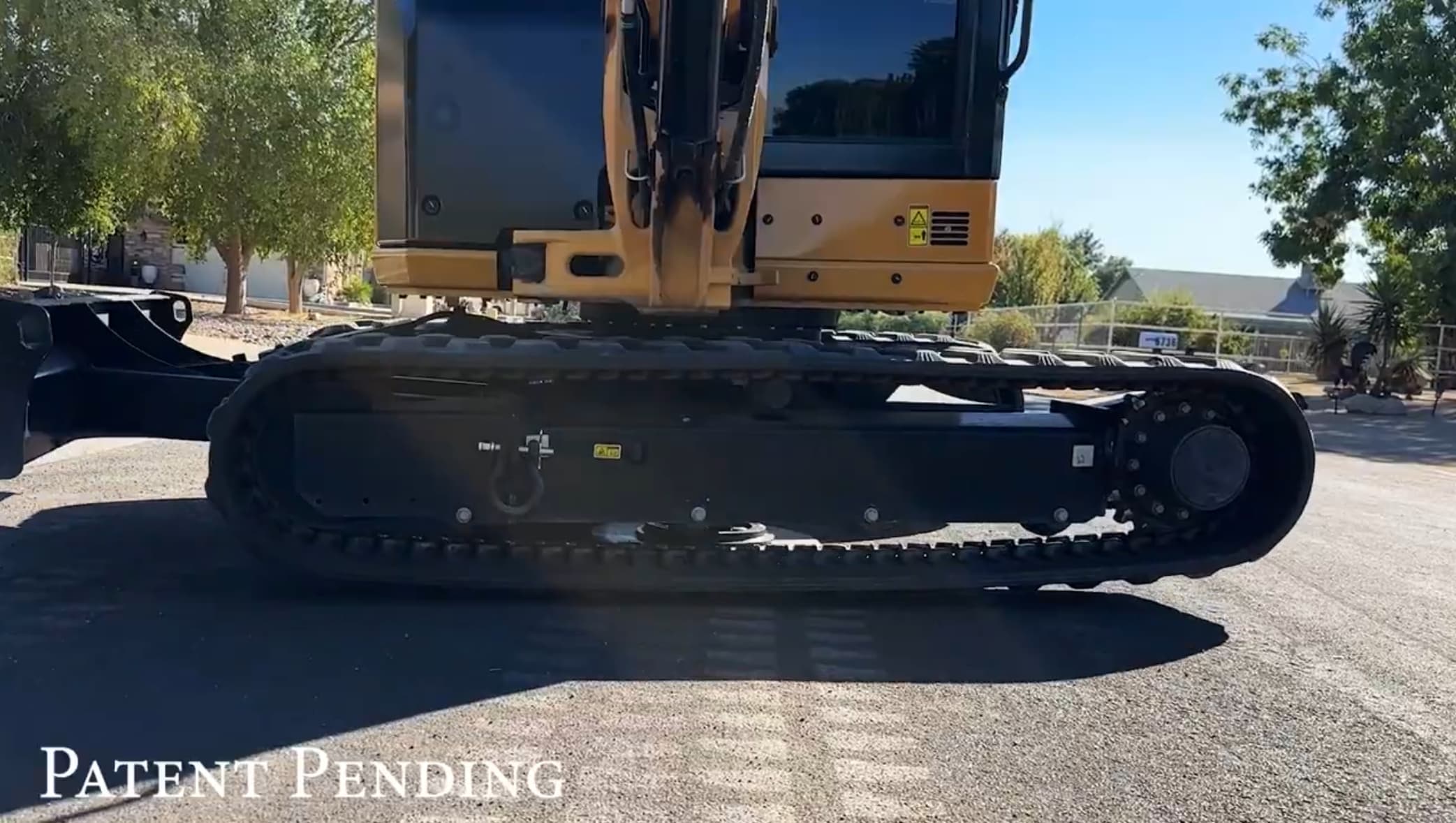
A patented foot drops, lifts the tracks clear, and lets the machine spin to any heading on its own turntable. No counter-rotating. No torn turf. No plywood.
Built and run on 2- and 5-ton machines; an 8-ton version is cut and ready to assemble. Available for OEM licensing.
See It Turn in Place
Working prototype on a Caterpillar 305 mini excavator, turning on dirt and pavement without scrubbing the tracks. The same mechanism is designed to scale across the 2- to 12-ton range.
Note on the footage: this was filmed before the patent issued, so the “Patent Pending” mark on screen is out of date. It has since been granted as U.S. Patent No. 12,679,457 on July 14, 2026.
The parts for an 8-ton (Cat 308) prototype are cut and ready to assemble. Detailed demonstration video available upon NDA execution.
Every time a tracked excavator turns, it tears up the ground
and chews up its own undercarriage.
To change heading, the tracks have to counter-rotate against the ground. That one motion scars turf, gouges asphalt, and grinds sprockets and rollers — which is why crews haul plywood and swamp mats to every finished-surface job, and why lawn repair keeps landing on the contractor's invoice. The cost shows up in time, money, and safety.
Torn-Up Turf and Hardscape
Lawns, asphalt, pavers, and finished concrete get scarred by every turn — two parallel gouges in the grass. The restoration bill lands on the contractor.
Undercarriage Wear
Counter-rotating is the number-one driver of premature track, sprocket, and roller wear — usually the biggest non-fuel line item on the machine.
Jobs You Have to Turn Down
Crews stay off finished surfaces, decorative hardscape, and good turf — or lay plywood first. Either the job costs more, or it goes to a wheeled machine instead.
Damage Claims
Property-damage claims from track tear-up are routine in residential, right-of-way, and urban infill work — and unavoidable with the way tracks turn today.
The excavator rotates itself —
using its own existing systems.
The Excavator Foot is a hydraulic plate-and-turntable assembly that mounts to the underside of the main frame. The operator triggers a four-step sequence — and the machine pivots in place on its own.
Anchor the Bucket
Boom lowers, bucket engages the ground. The cabin is now mechanically fixed relative to the earth through the boom-bucket-ground chain.
Extend the Foot
Hydraulic linkage drives the turntable assembly downward. As it contacts ground, the tracks lift clear — the entire main frame is now supported on the foot.
Rotate the Frame
With the cabin anchored by the bucket, the excavator's own rotary motor spins the main frame and tracks freely on the turntable — to any heading.
Retract and Resume
Foot retracts, tracks settle on ground at the new heading, bucket releases. Net result: a full reorientation with zero ground scrub.
Why this is hard to design around
Operators already do a crude version of this by hand. Set the bucket flat on the ground, push down until the tracks are a few inches up, and swing the house to drag the machine around. Every experienced hand knows the trick, and every one of them knows it is slow, hard to repeat, and rough on the boom. The Excavator Foot is that move, engineered — done from the seat, on a turntable built to carry the load.
The mechanism uses the excavator's existing rotary motor and boom — not a new powertrain. Without anchoring the cabin via the bucket, firing the rotary motor with tracks lifted simply counter-rotates cabin against tracks (Newton's third law) — net rotation: zero. The bucket-anchor step is not a design choice; it is a physical requirement of any system that uses the OEM's own rotary motor to do the work.
Any competing implementation that uses a different rotation mechanism (e.g., a driven turntable motor) adds cost, complexity, and a redundant powertrain — and still infringes the combination claim. The path of least resistance for an OEM is to license, not design around.
Two working prototypes.
2-ton and 5-ton class.
The mechanism has been built and operated on two machine classes, validating the load math, hydraulic geometry, and structural design. Parts for an 8-ton prototype are cut and ready to assemble.
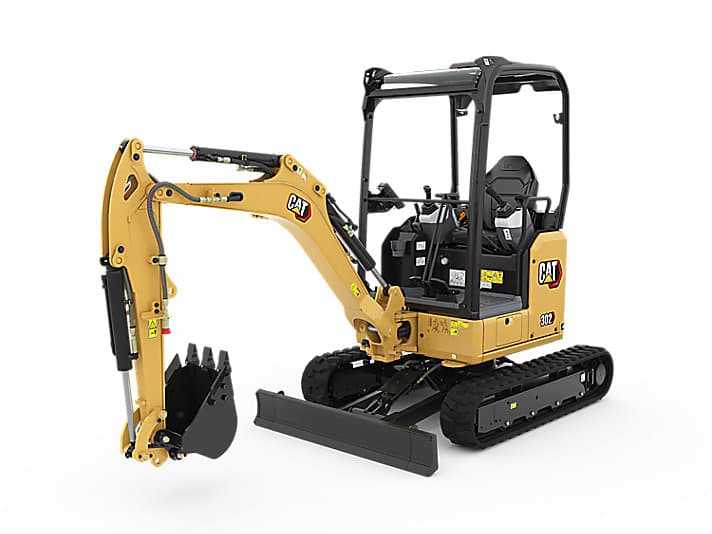
2-ton class
Caterpillar 302 — first prototype
- Mechanism geometry validated
- Operator sequence proven
5-ton class
Caterpillar 305 — featured in public demo
- Full operational cycle on dirt and pavement
- Bucket-anchor sequence repeatable in field conditions
8-ton class
Caterpillar 308 — parts cut, not yet assembled
- Production-grade machined parts, ready to assemble
- Not yet run; demonstrations once it is assembled
Prototypes are engineering validation, not retail product. The Excavator Foot is offered for OEM integration into factory production lines.
Built to be a factory option,
not an aftermarket bolt-on.
The Excavator Foot integrates with the host machine's existing hydraulic circuit and rotary motor. It belongs on the assembly line — designed in, not strapped on.
Class-Spanning Design
One mechanism, scaled by load math, fits the 2-ton through 12-ton tracked-excavator range. A single program covers a complete product line.
Native Hydraulic Integration
Uses the host machine's existing hydraulic circuit and rotary motor. No new powertrain, no parallel pump, no redundant control surface — lower BOM impact, faster qualification, clean fit into existing assembly workflows.
Engineering Package Ready
Drawings, hydraulic schematics, load analysis, and prototype data available for evaluation under NDA. Designed to drop into existing manufacturing workflows.
What it's worth, per machine.
Contractors buy on three things: time, money, and safety. The Excavator Foot moves all three — and hands the manufacturer a fourth that competitors cannot copy.
Stop laying plywood
No more setting mats down and picking them back up. No more four-point shuffle to get turned around in a tight side yard. More billable hours on exactly the jobs where surface protection used to eat the morning.
Tracks last longer
Counter-rotating is what eats tracks, sprockets, and rollers — every manufacturer already publishes operator guidance telling crews to avoid it. Take it out and those intervals stretch. Lawn-repair bills drop. The machine costs less to own.
Nobody gets out of the cab
No churning up the ground while turning next to an open trench — an OSHA 1926 Subpart P concern. No climbing down to drag mats around. Fewer property-damage incidents on the books at renewal time.
Competitors can't copy it
Apparatus claim plus combination claim, granted into early 2045. Years of exclusivity in a category where every machine looks like every other machine — and designing around it means adding a second powertrain, which breaks the cost model.
And they compound.
These don't just stack up, they feed each other. Less wear means less downtime, which means fewer trips to the service bay. Faster turns mean lower labor cost and less late-shift fatigue. And exclusivity means pricing power, which means healthier dealer margins.
Each one amplifies the others — which is the difference between a feature you add to a spec sheet and a reason someone picks your machine.
Two ways to go deeper.
We're engaged in conversations with manufacturers in the tracked-excavator and compact-construction segments. The right next step depends on where you are.
Schedule a Demo
See a working prototype in person, walk through the mechanism, and ask engineering questions live. Best for early-stage interest.
Request a DemoRequest the Technical Package
NDA-gated access to engineering drawings, claim charts, royalty model, and manufacturing cost analysis. Best for serious evaluation.
Begin NDA Process