From a jobsite problem
to a patented mechanism.
How a contractor who got tired of tearing up customers' lawns built and patented a way for a tracked excavator to turn in place.
Every contractor knows the moment.
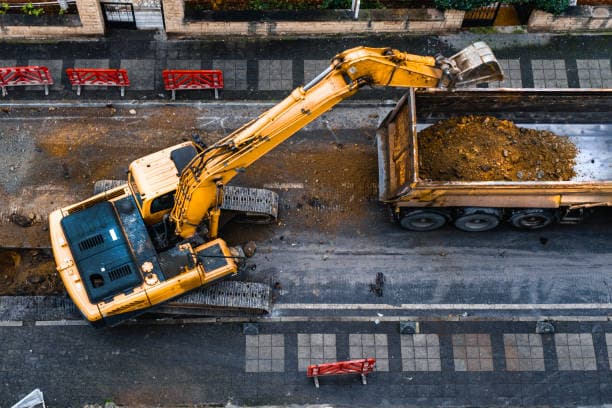
You finish a precise dig on a customer's property. The job is done. Now the machine has to come off the lawn — but to drive it out, the tracks have to swivel. And every swivel grinds two parallel scars into the grass.
Either you accept the damage and eat the restoration cost, or you spend hours laying plywood and matting to protect the surface. Either way, you're paying for a flaw in the machine.
After enough jobs like that, the question stops being "how do I avoid this" and starts being "why hasn't anyone fixed this on the equipment itself?"
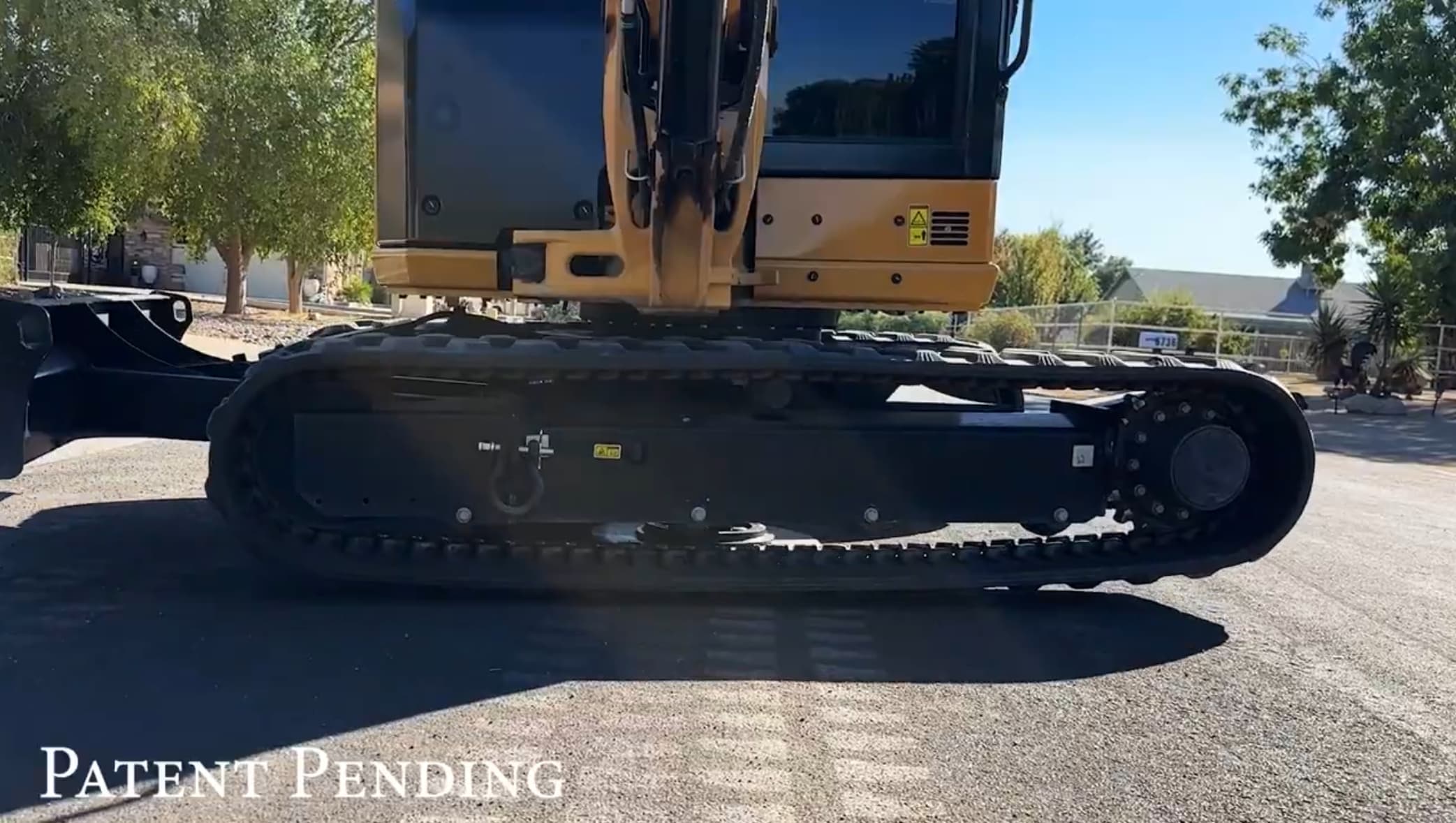
Two working prototypes. A third in parts.
The first prototype was built and operated on a 2-ton Cat 302 to validate the core geometry. The second on a 5-ton Cat 305 to confirm that the load math and hydraulic timing scaled properly. Both work — and the public demonstration video shows the 305 cycling through the full operational sequence.
The third prototype, on a Cat 308 (8-ton class), is cut and ready to assemble. At that size, the mechanism is no longer compact-equipment scale — it's the size used by right-of-way contractors, urban infill builders, and infrastructure crews. That's the size that matters to the OEM conversation.
What the patent protects.
U.S. Patent No. 12,679,457 issued on July 14, 2026 with 11 claims — two independent claims (the apparatus itself, and the excavator-plus-apparatus combination) plus nine dependents. With patent term adjustment, protection runs into early 2045.
Verify it yourself
- Official title
- Excavator Rotating Assembly
- Patent number
- US 12,679,457 B2
- Granted
- July 14, 2026
- Application no.
- 18/594,097
- Filed
- March 4, 2024
- Pre-grant publication
- US 2025/0153770 A1
- Provisional
- 63/598,078 — November 11, 2023
- Inventor
- Kable Darren Record
Apparatus claim
The hydraulic plate-and-turntable mechanism: frame-mounted attachment plate, parallel-linkage hydraulic lift, and ground-engaging turntable assembly that allows free rotation under load.
Combination claim — the moat
The full operational system: excavator (cabin, boom, bucket, main frame, tracks, rotary motor) plus the apparatus, used in the four-step sequence (anchor → lift → rotate → retract).
This claim is what catches anyone who builds a working version of this idea using the host machine's existing rotary motor — which is the only economically viable way to do it.
Design-around tested — by the inventor
Alternate architectures were prototyped and stress-tested, including bucket-free stabilization. Every workable configuration converges on the same sequence the patent claims: anchor with the bucket, lift from under the frame, rotate on a ground-engaging foot. The combination claim covers that sequence independent of how the lift itself is built — a swinging boom throws the balance point, and forward-projecting stabilizers foul the tracks the moment the house rotates.
Detailed IP package available under NDA
The full claim chart, prosecution history, prior art analysis, and design-around study are available to qualified evaluators under a mutual NDA. Engineering drawings, hydraulic schematics, load analysis, and royalty model are released on the same path.
Kable Record
Kable Record is a construction entrepreneur and inventor based in the United States. The Excavator Foot grew out of years of running heavy equipment on residential, ROW, and commercial jobsites — and the simple observation that the most expensive moments on a jobsite are often the ones the equipment can't avoid.
In addition to this work, Kable is the founder of OSQR, an AI operating system for small businesses, and the author of the Fourth Gen Formula — a framework for generational wealth-building that he develops alongside his invention work.
His operating preference is to license patented mechanical inventions to OEMs who can integrate them into existing manufacturing programs, rather than build a parallel aftermarket business around them. That's the path being pursued for this technology.