Why excavators tear up lawns
— and what actually stops it.
Two parallel scars in the grass, every time the machine changes heading. It is not the weight and it is not the driving. It is one specific motion — and once you see it, the fixes sort themselves into the ones that help and the ones that only look like they do.
The cause: counter-rotation
A tracked machine cannot steer the way a wheeled machine does. There is nothing to point in a new direction. To change heading, one track has to drive forward while the other holds or drives back — and the track skids sideways across the ground while it happens.
That sideways skid is the whole problem. The full weight of the machine is sitting on the track while it scrubs across the surface, so the grousers act like a rasp: they shear the sod away from the soil, break the root mat, and leave the two curved gouges everyone recognises.
The useful consequence is that driving across a lawn is not what wrecks it. Straight-line travel on rubber tracks is comparatively gentle and often leaves nothing worse than flattened grass. Nearly all the damage is concentrated in the turns.
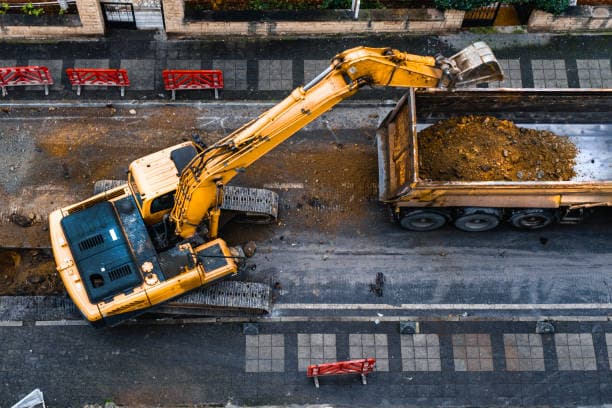
Worth knowing: this is also the single largest driver of undercarriage wear. The same scrub that tears turf grinds sprockets, rollers and track links. Every major manufacturer publishes operator guidance telling crews to minimise counter-rotation — which is a fairly direct admission that the machine does something expensive every time it turns.
What operators do about it today
All of these are real and all of them help. None of them is free, and it is worth being honest about what each one actually costs.
Plywood, track mats and swamp mats
Genuinely effective. Spreads the load and takes the shear.
Time. Sheets have to be hauled, laid, moved as the machine advances, then picked up and cleaned. On a small job the matting can take longer than the digging, and mats are consumable — they split, they get lost, they get stolen.
Turf tracks and wider rubber tracks
Lowers ground pressure and helps a lot on straight-line travel and soft turf.
Does not fix the actual problem. Ground pressure is not what tears sod — sideways shear is. A wider, smoother track still scrubs when the machine counter-rotates; it just leaves a broader scar. Worth having, not a solution.
Route planning and turn discipline
The cheapest real improvement. Plan the approach so the machine makes long, gradual, rolling turns instead of spot turns, and keep both tracks moving.
Requires room you often do not have. In a side yard, behind a house, or between a foundation and a fence, there is no space for a wide turn — which is exactly where the finished surfaces are.
The bucket-lift trick
Set the bucket flat, push down until the tracks are a few inches clear, then swing the house to drag the machine around. Most experienced hands know it, and on the right ground it works.
Slow, hard to repeat consistently, and rough on the boom, stick and swing bearing — you are using the work group as a jack and a pivot. It also needs firm ground under the bucket. It is a workaround, not a feature.
Working with the conditions
Dry, firm, dormant turf recovers far better than wet turf. Frozen ground is close to bulletproof. Scheduling the finished-surface portion for the right conditions is free.
You rarely control the schedule. Wet spring ground is when the damage is worst and when a lot of the work happens anyway.
Fixing track scars in grass
First look at what kind of scar you have. If the grass is pressed flat or scuffed but still rooted, it is a pressed scar, and it mostly needs help standing back up. If the sod has been sheared loose, rolled up or pushed into a ridge with bare soil showing, it is a torn scar. That sod will not knit back down by itself.
1. Rake
Rake the pressed grass upright and pull out loose clods. On a torn scar, lift the loose sod off. If a piece is still green and in one strip, set it aside in the shade, because it can go back down.
2. Fill the ruts
Loosen the bottom of each rut with a garden fork so new soil bonds to the old. Fill to grade with screened topsoil, or topsoil mixed with compost, and leave it slightly high because it settles. Don't fill with clay spoil from the dig; grass struggles in it.
3. Reseed or sod
Pressed scars: spread seed that matches the lawn, then cover it with about a quarter inch of topsoil. Torn scars: cut the damaged area out square with a flat spade, lay sod (or the strips you saved) level with the lawn around it, and butt the seams tight.
4. Roll and water
Roll or tamp it lightly so seed and sod are pressed into the soil. Then water every day, lightly for seed and deeply for sod, until it roots. Keep vehicles and foot traffic off it until then.
Timing
- Do it the same day if you can. Torn sod lying on top of the lawn dries out fast in summer heat, and once it browns it will not root.
- If the ground is wet, wait until it is dry enough to rake without smearing. Working mud just makes a flatter, harder scar.
- Seed when the grass is growing. Cool-season lawns (fescue, bluegrass, rye) take seed best in early fall or spring. Warm-season lawns (Bermuda) take it in late spring and summer. St. Augustine and most zoysia do not grow well from seed, so patch those with sod or plugs.
- Expect two to three weeks before new sod can take foot traffic, and about three mowings before new seed looks like the rest of the lawn.
Rough cost per scar
One spot turn on a 5-ton mini excavator leaves two curved scars, roughly 15 to 25 square feet of damaged lawn together. Ballpark US figures for fixing that one turn:
- Reseed it yourself: about $10–25 in seed and topsoil, and 30–45 minutes.
- Re-sod it yourself: about $15–40 in sod and topsoil (sod runs roughly 50¢ to $1 a square foot by the pallet), and about an hour.
- Hire a landscaper: often $150–400 for a small patch, because most charge a trip minimum no matter how small the job.
Prices vary by region and season, so treat these as a starting point. The number that matters is the multiplier: a job with ten spot turns on a lawn is 150 to 250 square feet of repair. That is why it belongs in the bid rather than in the apology.
Why none of it actually solves the problem
Look at that list together and a pattern shows up. Every option is one of three things: a consumable you pay for in time (mats), a compromise that costs you work (avoid the surface, or hand the job to a wheeled machine), or a workaround that is slow and hard on the machine (the bucket-lift trick).
Not one of them changes the underlying fact. The machine still has no way to change heading without shearing the ground it is standing on. Everything above is a way of managing a limitation that the equipment itself has never addressed.
Which raises the obvious question — the one that turns out to have an answer.
Take the skid out of the turn.
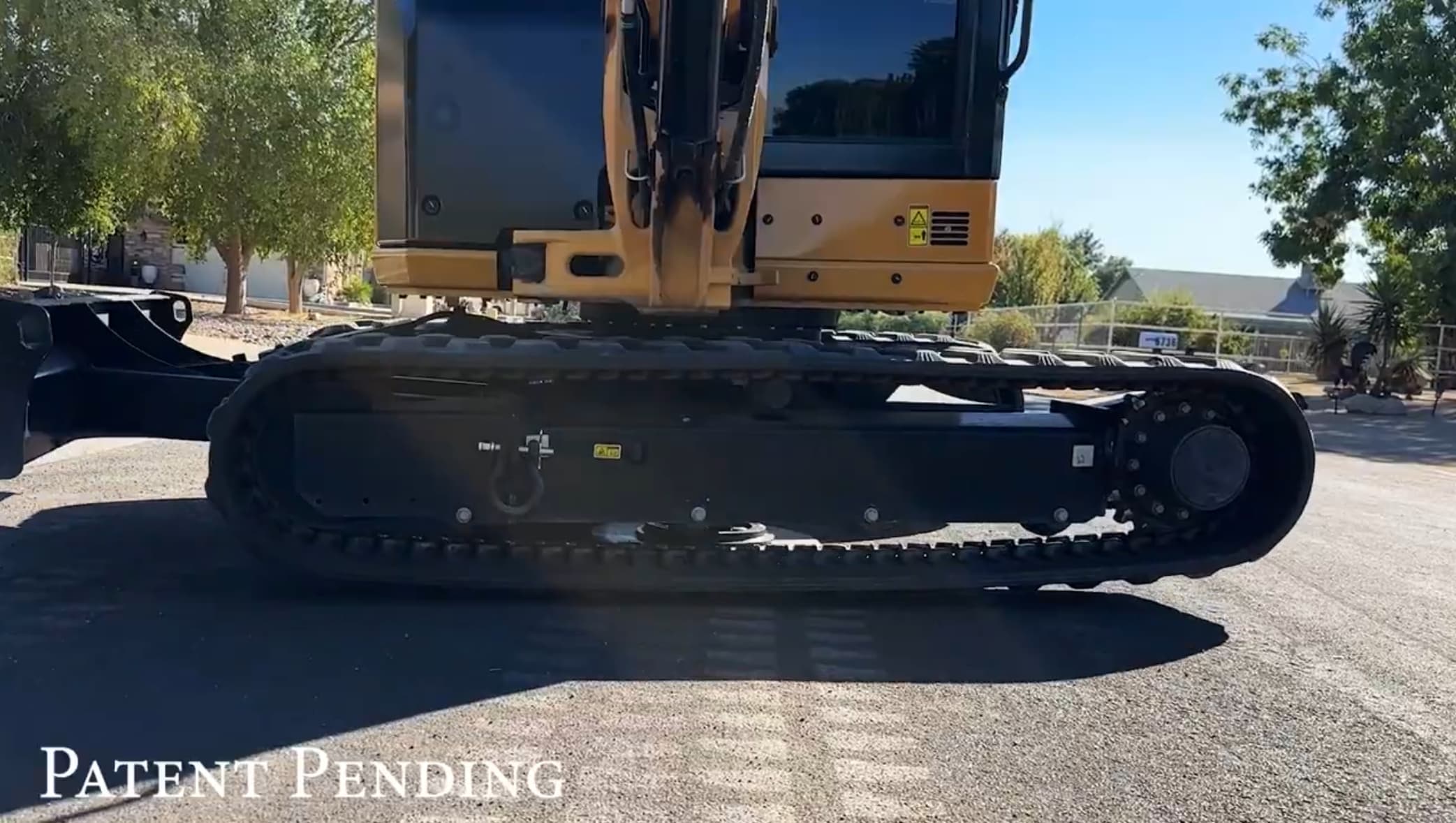
The Excavator Foot is the bucket-lift trick, engineered — and done properly from the seat. A hydraulic plate-and-turntable assembly mounts under the main frame. The bucket anchors, the foot extends until the tracks lift clear, and the machine's own rotary motor spins the frame and tracks to any heading on the turntable. Then the foot retracts and the tracks settle back down.
The tracks never move across the ground, because while the machine is turning they are not touching it. No shear means no scarred sod, no gouged asphalt, and none of the undercarriage scrub that comes with a counter-rotation.
It is covered by U.S. Patent No. 12,679,457 (Excavator Rotating Assembly, granted July 14, 2026), and has been built and run on 2- and 5-ton machines. Parts for an 8-ton version are cut and ready to assemble.
Straight answer: you cannot buy one yet
This is not an aftermarket attachment and there is no order page. The Excavator Foot integrates with the machine's own hydraulic circuit and rotary motor, which means it belongs on the assembly line rather than bolted on afterwards. It is being licensed to the manufacturers who build these machines.
If you want it on your next machine, the most useful thing you can do is tell your dealer you want it. Manufacturers move on what their dealer network keeps hearing, and right now that demand is the argument.
Watch it turn in place
A working prototype on a Cat 305, cycling through the full sequence on dirt and pavement. Under two minutes, no narration needed.
See the demoIf you build these machines
Engineering drawings, hydraulic schematics, load analysis, claim chart and royalty model are available to qualified evaluators under a mutual NDA.
Request the technical package